NAME IT TO TAME IT: WHY NAMING YOUR EMOTIONS CAN HELP
Have you ever known you were feeling something but couldn't figure out what it was? You felt weird, or off, or vaguely bad in a way that followed you around all afternoon. Then you finally landed on the right word (I'm disappointed. I'm embarrassed. I'm lonely. I'm resentful.) and suddenly the whole thing made a little more sense.
Psychiatrist Daniel Siegel popularized the phrase "name it to tame it" to describe putting words to what we're feeling. I love the phrase because it makes an important emotional skill sound so simple: before we figure out what to DO with an emotion, it helps to figure out what the emotion actually is. Of course, simple doesn't mean easy, and most of us have had very little practice with this!
WHY NAMING AN EMOTION CAN HELP
There's actually research behind the idea that putting feelings into words changes how we experience them. Researchers call this affect labeling, which basically means identifying an emotional experience with language. Brain-imaging research has found differences in neural activity when people label emotional stimuli compared with just experiencing them, although the process is more complicated than the popular idea that naming an emotion "turns off" the emotional part of the brain (I wish it were that easy).
There's also a much more practical way to understand why naming helps: different emotions give us different information!! "I feel bad" doesn't give me much to work with. But "I'm disappointed" might tell me something I hoped for didn't happen, and "I'm lonely" might point toward a need for connection. "I'm resentful" might make me curious about whether I've been ignoring a boundary, "I'm embarrassed" might tell me I'm worried about how I'm being perceived, and "I'm anxious" might point toward uncertainty or something I don't feel prepared for. Naming the emotion won't always make it disappear, but it can give us a much clearer sense of what we're responding to and what we might need next.
EMOTIONAL GRANULARITY: GETTING MORE SPECIFIC
There's a name for our ability to tell different emotional experiences apart: emotional granularity. Someone with lower emotional granularity might mostly notice that they feel good, bad, stressed or upset. Greater granularity means making finer distinctions. Maybe I'm not just upset, I'm disappointed and a little embarrassed. Maybe I'm not just stressed, I'm overwhelmed because I have no idea what's expected of me. Maybe what I've been calling anxiety is actually a mix of excitement and uncertainty.
Research has linked greater emotional granularity with aspects of emotional regulation and well-being, although researchers are still studying exactly why those relationships exist and how much granularity itself can be intentionally changed. For me, developing this skill has meant learning that emotions are much more specific than I once realized. The better I've become at distinguishing between them, the easier it has become to understand what my internal experience may be trying to communicate.
WHY IDENTIFYING YOUR FEELINGS CAN BE HARD
If you struggle to identify what you're feeling, you're not doing emotions wrong! A lot of us were never taught much emotional vocabulary. Maybe you grew up in a family where certain emotions just weren't talked about, or where sadness was acceptable but anger WASN'T. You might have learned to move past uncomfortable feelings as fast as possible, or other people's emotions took up so much space that you got really good at reading THEIR feelings and not so good at reading your own.
And sometimes emotions are legitimately hard to untangle. We can feel several things at once: anger sitting right next to grief, relief alongside sadness, excitement that feels weirdly similar to anxiety in the body. Sometimes "I don't know what I'm feeling yet" is the most accurate answer available. Naming emotions is a skill, and skills get easier with practice!
HOW TO PRACTICE "NAME IT TO TAME IT"
One of my favorite tools for this is a feelings wheel. Instead of forcing yourself to answer "What am I feeling?" on the spot, you can start broad and get more specific. Maybe you know you're somewhere in the neighborhood of sadness, and from there you realize "disappointed" fits better. Or maybe what looked like anger at first turns out to be betrayal or frustration once you look a little closer.
You can also work backward from what you're noticing. What's happening in my body? What do I want to do right now? What happened right before I started feeling this way? What thoughts keep showing up? If I had to guess three emotions, what would they be? You don't need to find the one perfect word, because emotions aren't a test you're trying to pass. The goal is just to get a little more curious and a little more specific about your own experience.
Sometimes naming an emotion lowers its intensity, and sometimes it doesn't. Sometimes you name it and realize, oh, I'm actually really angry, and now you have an emotion that still needs your attention. That's okay too! Taming every feeling until it goes away was never the point. What we want is to understand what you're experiencing well enough that you have more CHOICE in how you respond.
So the next time you catch yourself thinking "I just feel weird," maybe pause there for a second. Pull out a feelings wheel if you need one, get curious, and see whether there's a more specific word hiding underneath "weird." You might be surprised by how much information shows up once you can name what you're actually feeling :)
If this resonates with you, especially if anxiety or overwhelm makes it hard to understand what you're feeling or know what you need, this is something we can explore together in therapy. Learn more about how I work with anxiety →
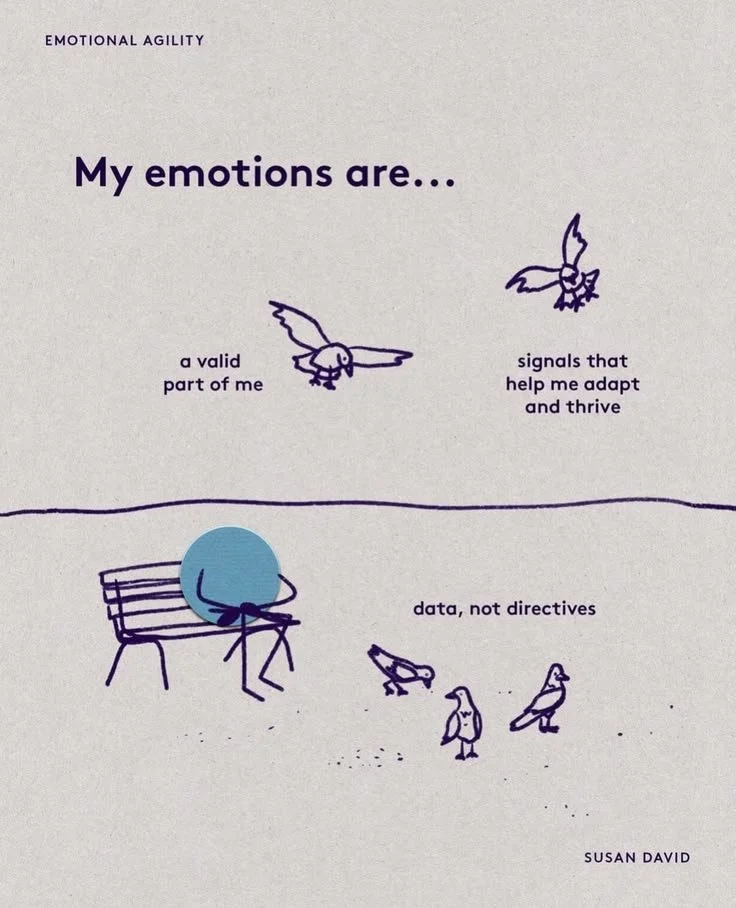
credit: www.instagram.com/susandavid_phd
