RECLAIMING ANGER: WHAT HAPPENS WHEN YOU’VE LEARNED NOT TO BE ANGRY
I've noticed that anger is one of those emotions people often have a complicated relationship with. Some of us don't just dislike feeling angry—we've built an entire identity around not being an angry person.
Maybe you're understanding. Patient. Empathetic. Easygoing. You're good at seeing where other people are coming from, giving people the benefit of the doubt, and finding an explanation for why they behaved the way they did. When someone hurts you, your brain may get to their perspective before you've even had a chance to acknowledge your own.
They're going through a lot. They probably didn't mean it that way. That's just how they are. I know they love me. Maybe I'm being too sensitive. It's really not that big of a deal.
Understanding other people can be a beautiful quality. But sometimes our ability to understand everyone else becomes a very effective way of never allowing ourselves to be angry with them.
WHY ANGER CAN FEEL SO UNCOMFORTABLE
We learn a lot about emotions from the environments we grow up in. Maybe anger in your family meant yelling, intimidation, slammed doors, punishment, withdrawal, or unpredictability. If that's what anger looked like, it makes sense that you might have decided I don't want to be an angry person.
Or maybe your anger wasn't welcomed. You were allowed to be happy, helpful, grateful, or agreeable, but anger got you labeled dramatic, disrespectful, difficult, selfish, or too sensitive. Maybe expressing anger threatened connection, so you learned to soften it, hide it, or turn it inward instead.
There can also be cultural, religious, and gendered messages around who is “allowed” to be angry and what anger supposedly says about someone's character. If you've spent years receiving the message that being good means being forgiving, patient, pleasant, selfless, or accommodating, anger can feel incompatible with the person you're supposed to be.
Eventually, you may become so practiced at moving away from anger that you barely recognize it when it's there.
ANGER IS DIFFERENT FROM WHAT WE DO WITH ANGER
Part of reclaiming anger is separating the emotion itself from behaviors we associate with it.
Anger does not automatically mean yelling. It doesn't mean being cruel, aggressive, threatening, or destructive. Those are behaviors someone might engage in while angry, but they are not the emotion itself.
You can be angry and speak calmly. You can be angry and take time before responding. You can be angry and still care deeply about the person you're angry with. You can even decide not to act on your anger at all.
The goal isn't to treat every angry feeling as proof that you're right or that someone else is wrong. Emotions aren't verdicts. But they are information, and anger deserves the same curiosity we might offer sadness, fear, or anxiety.
ANGER CAN TELL US THAT SOMETHING MATTERS
Anger often shows up when something feels unfair, when a boundary has been crossed, when something important to us is threatened, or when our needs have repeatedly gone unacknowledged.
That doesn't mean anger always interprets a situation perfectly. Sometimes we're angry because of a misunderstanding. Sometimes an old experience gets activated in a new situation. Sometimes we're angry about something another person couldn't reasonably have known or prevented.
But instead of immediately asking “How do I stop being angry?” we can get curious about “What is my anger responding to?”
Maybe you're angry because you've said yes too many times when you wanted to say no. Maybe you're angry because someone keeps making jokes at your expense. Maybe you're angry because you're doing significantly more emotional labor in a relationship. Maybe you're angry because someone hurt you and you've spent months explaining why they didn't mean to.
Anger might not tell you exactly what to do next, but it may be pointing toward something worth paying attention to.
PEOPLE-PLEASING CAN TURN ANGER INWARD
When anger toward other people doesn't feel safe or acceptable, sometimes we redirect it toward ourselves.
Instead of “I'm angry that they treated me that way,” we think, “I shouldn't have let that happen.” Instead of “I'm frustrated that they keep expecting this from me,” we think, “Why can't I handle more?” Instead of “I'm angry that my needs weren't considered,” we think, “I'm so needy.”
Self-blame can sometimes feel safer than anger because it gives us something to control. If I'm the problem, maybe I can fix myself and prevent this from happening again. Acknowledging anger toward someone else can be more complicated because it may force us to recognize something about the relationship that we don't want to see.
Sometimes reclaiming anger means noticing when self-criticism is covering up a very reasonable “I didn't like how I was treated.”
RESENTMENT CAN BE USEFUL INFORMATION
I think resentment is especially important for people-pleasers to pay attention to. We often treat resentment as something ugly we should get rid of, but resentment can sometimes be the accumulated result of repeatedly abandoning ourselves.
Maybe you keep saying yes while secretly wishing someone would notice how much you're doing. Maybe you offer help before anyone asks and then feel hurt when they don't reciprocate. Maybe you avoid setting a boundary because you don't want someone to be disappointed, only to become increasingly frustrated that they keep expecting the same thing from you.
In those situations, resentment isn't necessarily proof that the other person is doing something wrong. Sometimes it's information that something about the way you're participating in the relationship isn't working for you anymore.
Instead of shaming yourself for feeling resentful, you can get curious about what the resentment might be asking you to acknowledge.
YOU CAN UNDERSTAND SOMEONE & STILL BE ANGRY WITH THEM
This is one of the biggest pieces of reclaiming anger for me: understanding someone's behavior doesn't require us to stop having feelings about how that behavior affected us.
Someone can have a painful history and hurt you. Someone can have good intentions and cross a boundary. Someone can love you and behave in a way that makes you angry. Someone can be doing the best they know how to do and their best can still have an impact on you.
Empathy doesn't require self-erasure.
You don't have to choose between understanding someone else's humanity and acknowledging your own experience. There is room for both.
RECLAIMING ANGER DOESN’T MEAN BECOMING ANGRIER
The goal of reclaiming anger isn't to become furious about everything or to treat anger as automatically correct. It's to expand the range of emotions you're allowed to have.
Maybe you're someone who has become very comfortable with sadness but not anger. Maybe anxiety feels acceptable because it turns the focus inward, while anger feels dangerous because it points outward. Maybe forgiveness comes easily, but acknowledging that something was unfair feels much harder.
Reclaiming anger can be as simple as allowing yourself to say, “I'm angry about what happened.” You don't have to immediately forgive it, justify it, confront anyone, or decide what it means about the relationship. You can start by letting the emotion exist long enough to understand what it's trying to tell you.
Sometimes anger will lead you toward a boundary. Sometimes it will lead you toward grief. Sometimes you'll realize the situation wasn't what you initially thought. Sometimes it will show you how much you've been carrying without acknowledging it.
The point isn't to obey your anger. It's to stop automatically silencing it.
You are allowed to be compassionate and angry. Understanding and angry. Loving and angry. You can be a kind person who sometimes gets really, really pissed off. Your anger doesn't cancel out your empathy; sometimes it simply reminds you that you deserve some of that empathy too.
If this resonates with you—especially if you tend to minimize your anger, explain away hurt, or feel responsible for staying easy and understanding in your relationships—this is something we can explore together in therapy. Learn more about how I work with people-pleasing →
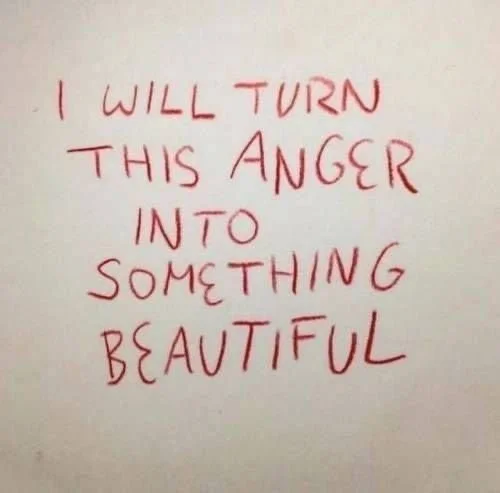
credit: source unknown
